Executive Context
Reprioritizing work is often necessary in volatile business environments. The executive challenge is not deciding what changes, but ensuring the organization maintains execution momentum after strategic priorities shift. Frequent reprioritization without disciplined alignment can slow progress rather than accelerate it.
Note: Every CareerO² client relationship begins with an Enterprise Performance Infrastructure Audit™ (EPIA™).
Executive Observations
- Strategic pivots require disciplined reprioritization—not simply new priorities.
- Gartner reports that traditional portfolio prioritization is often too slow to respond to disruption, leaving many organizations unable to effectively conduct on-demand reprioritization.
- Why this matters: Momentum is lost when priorities change faster than governance, resource allocation, and execution processes can adapt.
- Resource allocation determines whether new priorities become business results.
- McKinsey research finds that organizations that actively reallocate resources outperform those that rely on incremental allocation approaches.
- Why this matters: Changing priorities without shifting capacity, funding, and decision rights creates competing priorities instead of organizational focus.
- Strategic agility depends on changing the path—not constantly changing the destination.
- Harvard Business Review emphasizes that effective pivots adapt the means to achieve goals while maintaining strategic intent whenever possible.
- Why this matters: Organizations sustain momentum when employees understand what remains constant as priorities evolve.
Executive Reflection
When priorities changed, did your organization also change the resources, expectations, and management practices needed to sustain execution?
CareerO² Perspective
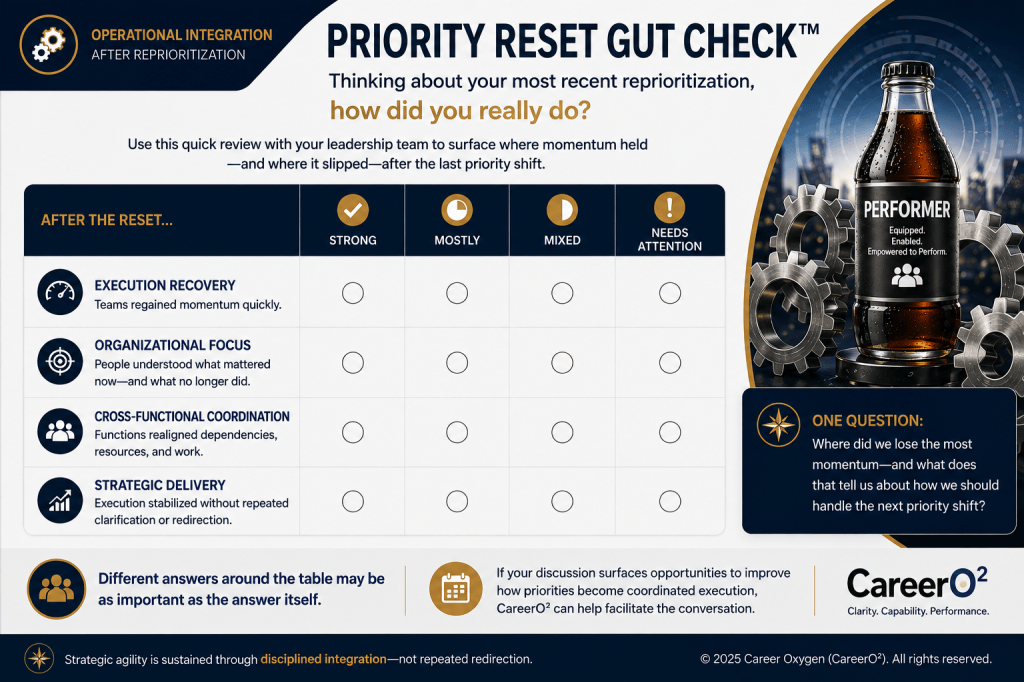
Organizations rarely lose momentum because priorities change. They lose momentum when leaders fail to convert new priorities into coordinated managerial action, operational clarity, and aligned execution. Strategic agility is sustained through disciplined integration—not repeated redirection.
Note: Every CareerO² client relationship begins with an Enterprise Performance Infrastructure Audit™ (EPIA™).
Strengthening Organizational Conditions
Condition Focus
Integrated execution after reprioritization
Organizations that strengthen this condition may be better positioned to realize:
Potential Gains
- Faster execution recovery
- Clearer organizational focus
- Better cross-functional coordination
- More consistent strategic delivery
Research Sources
- Gartner — Use Zero-Based Portfolio Prioritization to Realign With Strategy (August 8, 2024).
- Gartner — Reprioritize the Investment Portfolio (January 16, 2024).
- Harvard Business Review — Is It Time to Pivot Your Strategy? (July 30, 2024).
- McKinsey & Company — Tying Short-Term Decisions to Long-Term Strategy (May 20, 2024).
- McKinsey & Company — Keep Calm and Allocate Capital: Six Process Improvements (June 5, 2024).

