We Tell Employees to Own Their Careers. But Own Them Toward What?
For decades, career advice has placed much of the responsibility for career longevity on the individual.
Build relationships. Develop valuable skills. Demonstrate results. Accumulate knowledge and experience.
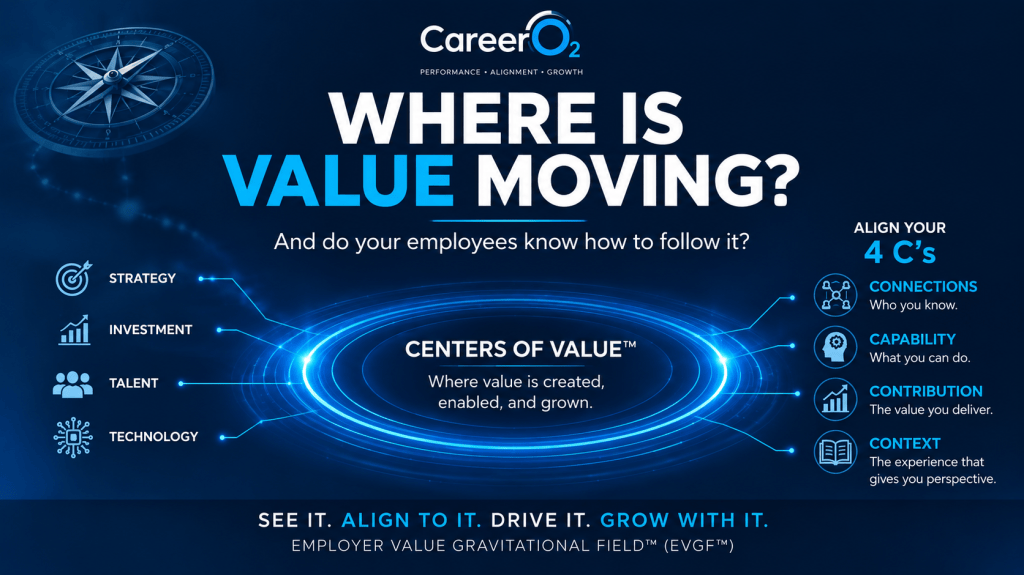
We think about these career assets as the 4 C’s:
- Connections — Who you know and the relationships you develop.
- Capability — What you know and what you know how to do.
- Contribution — Evidence that your capabilities have produced meaningful results.
- Context — The knowledge, judgment, wisdom, and experience that help you understand when and how to apply them.
Each matters.
But in today’s environment, mastering the 4 C’s may no longer be enough.
The World Economic Forum’s Future of Jobs Report 2025 found that employers expect 39% of workers’ existing skill sets to be transformed or become outdated by 2030. The same research projects substantial simultaneous job creation and displacement as technology, demographic change, economic pressures, and other forces reshape work.
McKinsey Global Institute has similarly estimated that, in a midpoint adoption scenario, up to 30% of current hours worked could be automated by 2030, accelerated by generative AI. Its research anticipates increasing demand in some occupations while demand declines in others.
The implication is bigger than reskilling.
Organizational value moves.
And when it moves, careers move with it.

The Missing Variable in Career Management
Consider an employee with excellent relationships, considerable expertise, years of experience, and a documented history of contribution.
That person can still become increasingly disconnected from what an organization needs next.
Not necessarily because the employee stopped performing.
Not because the employee failed.
And not because their knowledge suddenly became worthless.
The organization may simply be concentrating resources somewhere else:
- A product reaches maturity.
- A business unit loses strategic importance.
- Automation eliminates portions of a workflow.
- A merger creates duplication.
- A customer segment becomes more important.
- An emerging technology requires different capabilities.
- Investment moves from one priority to another.
- A new regulatory requirement creates demand elsewhere.
The employee may continue performing today’s job exceptionally well while the economic and strategic importance of that work is quietly changing.
This introduces a second performance question that organizations and employees should be asking.
Traditional performance management asks:
How well are you performing the work you have today?
We believe modern performance and career management must also ask:
How closely are your capabilities and contributions aligned with where organizational value is moving?
These are not the same question.

Organizations Often See the Movement First
This creates an important imbalance in the traditional idea that employees should simply “own their careers.”
Employees should absolutely take responsibility for their career decisions.
But organizations often possess information employees do not.
- Executives know where strategic emphasis is shifting.
- Finance knows where resources are being increased or reduced.
- Business leaders know which products, customers, markets, technologies, and operating capabilities are becoming more important.
- Talent Acquisition can see changing external hiring requirements.
- HR and Talent leaders can see emerging workforce requirements.
- Learning and Development can see new capability demands.
- Program and project portfolios reveal where transformation resources are being committed.
The information frequently exists.
The problem is that employees may experience these signals as fragmented announcements rather than as career and performance intelligence.
And even current expectations are not always sufficiently clear. Gallup reported that only 46% of U.S. employees strongly agreed that they clearly knew what was expected of them at work in 2024, while only 30% strongly agreed that someone at work encouraged their development.
Harvard Business Review has similarly addressed the difficulty employees experience trying to decode management priorities, noting that employees need to understand what matters to their managers while leaders can be unclear about communicating those priorities.
If employees struggle to see what matters today, understanding what will matter tomorrow becomes considerably more difficult.
This is the cultural problem we believe deserves more attention.
Introducing the Employer Value Gravitational Field™
Every organization has things toward which strategy, investment, leadership attention, talent, technology, and resources are disproportionately drawn.
We call this the Employer Value Gravitational Field™ — EVGF™.
Within that field are Centers of Value™: areas the organization increasingly depends upon to create value, enable value creation, protect existing value, or generate future growth.
A Center of Value might be:
- A strategically important product or customer segment
- Artificial intelligence or technology transformation
- Customer retention
- Regulatory compliance
- Operational efficiency
- A new market
- Supply-chain resilience
- Revenue growth
- Product innovation
- Cybersecurity
- Cost transformation
- A merger integration
- A critical organizational capability
The specific Centers of Value will differ by organization.
More importantly, they change.
That movement matters enormously to workforce performance.

Follow the Strategy. Follow the Money. Follow the Work.
EVGF™ is not intended to turn career management into speculation.
Quite the opposite.
Employees should be taught to recognize observable organizational signals.
- Where is investment increasing?
- Which initiatives receive executive attention?
- Which projects continue receiving funding?
- Which capabilities appear repeatedly in strategy discussions?
- Where is the organization hiring?
- Where has hiring stopped?
- Which functions are growing?
- What work is being automated?
- Which metrics increasingly dominate leadership conversations?
- Where are employees moving internally?
- Which products, customers, capabilities, or markets are receiving disproportionate resources?
Useful signals can include:
- Annual reports and leadership statements
- Strategic priorities
- Budget allocations
- Product and process transformation
- Changing workflows and goals
- New functions and roles
- Emerging capability requirements
- Internal mobility
- External hiring activity
- Technology investments
- Mergers and acquisitions
- Project and program funding
Viewed independently, these can appear to be ordinary business activities.
Viewed together, they can reveal where organizational value is moving.

The 4 C’s Still Matter—But Direction Matters Too
This changes how we think about the 4 C’s.
- Connections without organizational relevance can become a network around yesterday’s priorities.
- Capability without application can become knowledge the organization no longer needs in the same quantity.
- Contribution demonstrates historical value, but historical value does not automatically predict future demand.
- Context creates judgment and wisdom, but even deep experience must continually be applied to emerging organizational needs.
The 4 C’s therefore become more powerful when employees continuously ask:
Where are my 4 C’s positioned relative to the organization’s Centers of Value?
An employee who identifies movement early has choices.
- Develop a new capability.
- Join a strategic project.
- Build relationships in an emerging function.
- Apply existing expertise to a new business problem.
- Seek an internal assignment.
- Demonstrate contribution against a newly important metric.
- Pursue an internal role.
- Or, when appropriate, recognize that their long-term career aspirations and the organization’s direction are diverging.
That last possibility matters too.
Career longevity does not necessarily mean staying with one employer indefinitely.
It means remaining capable of making informed career decisions before circumstances make those decisions for you.

This Is an Opportunity System, Not Just a Risk System
The most obvious application of EVGF™ may appear to be workforce reductions.
We believe that interpretation is too narrow.
The same signals that can reveal declining organizational emphasis can reveal emerging opportunity.
- When investment moves, opportunities often move with it.
- When new capabilities become important, someone must develop them.
- When strategic programs receive funding, people must execute them.
- When technologies change workflows, organizations need people capable of operating in the new environment.
- When new products grow, new leadership and functional opportunities emerge.
- The objective is therefore not simply to help employees avoid being caught on the wrong side of organizational change.
It is to help them recognize where they might contribute next.

Research Suggests the Stakes Are Increasing
The speed and scale of workforce transformation make this more than a theoretical concern.
The World Economic Forum’s 2025 research, based on data from more than 1,000 companies, found that 63% of employers identified skills gaps as a key barrier to business transformation.
Deloitte’s 2025 Global Human Capital Trends research, drawing from nearly 13,000 business and HR leaders across 93 countries, found that 66% of managers and executives said most recent hires were not fully prepared, with lack of experience the most common shortcoming.
McKinsey has found that organizations adopting generative AI earlier place greater emphasis on talent development, with two-thirds of early adopters having a strategic approach to addressing future talent and skill requirements.
And the issue extends beyond employees.
Gallup’s State of the Global Workplace 2026 reports that global manager engagement fell to 22% in 2025, down nine percentage points from 2022. Deloitte found that 36% of managers said they were insufficiently prepared for the people-management aspects of their roles.
These studies examine different aspects of work and should not be treated as evidence of a single causal relationship.
But collectively, we believe they raise an important question:
Are organizations changing what they need faster than their performance and career-management cultures are helping people understand how to respond?
EVGF™ is our attempt to make that question actionable.

A Shared Responsibility for Career Relevance
This requires moving beyond the idea that career management belongs exclusively to either the employee or employer.
We propose shared responsibility.
Employers: Signal
Organizations should make their current and emerging Centers of Value sufficiently visible for employees to understand where business emphasis is moving.
This does not require disclosing confidential strategy or promising future employment.
It requires translating strategy into meaningful workforce signals.
Leaders and Managers: Translate
Managers need enough organizational context to explain what changing priorities mean for their teams.
Performance conversations can move beyond:
Here are your goals.
Toward:
Here is what the organization increasingly needs, why it matters, and how the work of this team contributes.
Employees: Align
Employees retain responsibility for deciding what to do with that information.
They can assess their Connections, Capabilities, Contributions, and Context against emerging Centers of Value and determine where adaptation may be necessary.
Organizations: Enable
If organizations genuinely want employees to adapt, they should create reasonable pathways through which adaptation can occur.
That may include learning, stretch assignments, projects, coaching, mentoring, internal mobility, new work experiences, and opportunities to demonstrate emerging capabilities.
This is where career development becomes directly connected to organizational performance.

Performance Management Must Look Forward, Not Only Backward
Most performance systems are naturally retrospective.
- What did you accomplish?
- Did you achieve your goals?
- How did you perform against expectations?
- What should improve?
Those questions remain important.
But an organization operating in an environment where capabilities, technology, and priorities continually change needs another conversation:
What will valuable performance look like next?
That changes learning and development as well.
The objective cannot simply be learning.
It must be performance capability applied where organizational value increasingly needs it.
The World Economic Forum expects 39% of workers’ core skills to change by 2030. McKinsey argues that AI-era learning and development will increasingly become part of the engine of organizational performance, adaptability, and resilience rather than simply a support function.
The question, therefore, isn’t merely:
What should our people learn?
It becomes:
What will our organization increasingly need people to create, enable, protect, transform, or grow—and are we preparing them to do it?
Where the Enterprise Performance Operating Model™ Enters
Organizations already have Centers of Value.
They already move.
Employees are already affected by that movement.
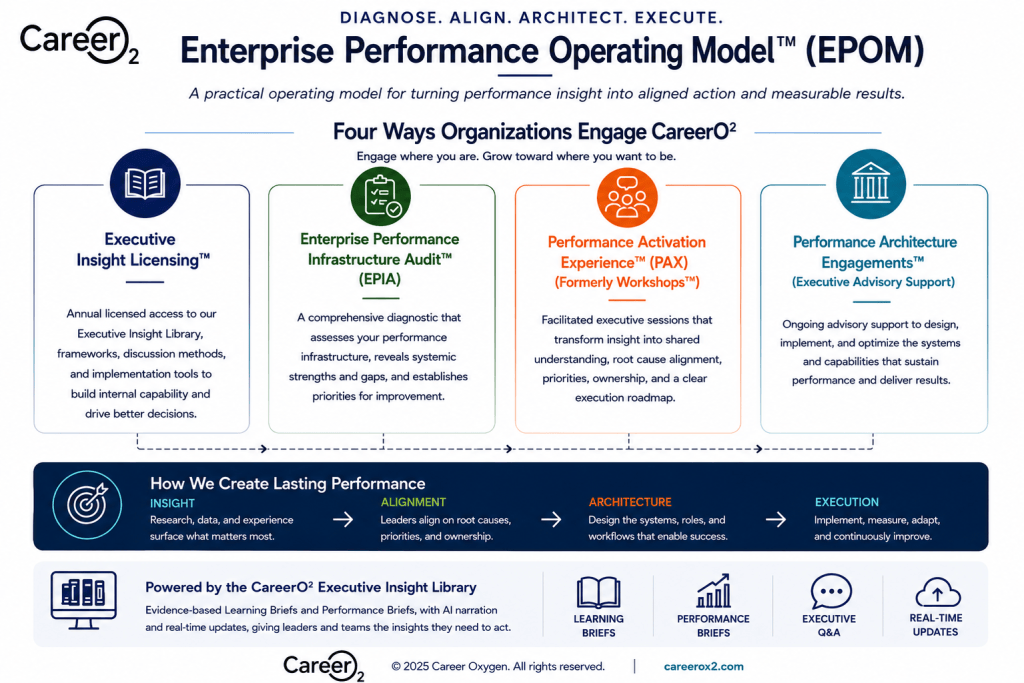
What is often missing is an operating discipline that connects enterprise direction, organizational conditions, management practices, workforce capability, and individual performance.
This is one of the problems we designed the Enterprise Performance Operating Model™ (EPOM™) to explore.
Imagine an annual enterprise performance calibration in which executives explicitly identify:
What must this organization create, enable, protect, transform, or grow during the next 12–24 months?
Then:
- Where will resources concentrate?
- Which capabilities become more important?
- Which operating conditions must change?
- Which management practices need strengthening?
- What will high-value contribution look like?
- What implications does this have for functions, teams, roles, and individuals?
HR, Talent, Learning and Development, and business leaders can then translate those answers into meaningful workforce signals.
Managers can translate them into team and performance conversations.
Employees can use them to make more informed decisions about their 4 C’s.
The organization gains a workforce increasingly capable of repositioning itself toward emerging business requirements.
Employees gain greater visibility into where opportunities—and risks—may be developing.
Neither side receives a guarantee.
Both gain better information with which to act.

A Different Conversation About Career Longevity
Employment will always involve uncertainty.
- Markets change.
- Strategies fail.
- Technologies disrupt.
- Leadership changes.
- Economic cycles intervene.
- Organizations merge, grow, contract, reorganize, and occasionally disappear.
EVGF™ cannot eliminate those realities.
Nor should an employer promise employees permanent security that it cannot guarantee.
We believe organizations can offer something different:
greater visibility.
Tell people what matters.
- Help them understand why it matters.
- Show them where organizational value appears to be moving.
- Give managers the ability to translate that movement.
- Create reasonable opportunities for people to adapt.
- And ask employees to take responsibility for what they do with that information.
A layoff announcement should not be the first unmistakable signal that organizational value moved.
A stalled career should not be the first indication that someone’s capabilities have drifted away from emerging organizational demand.
And an external job posting should not be the first time existing employees discover which capabilities their employer suddenly considers important.
The goal is not permanent employment.
The goal is a healthier performance culture in which organizations and employees can see change earlier and respond more intelligently.
Because perhaps the future of career management isn’t simply teaching employees how to become more valuable.
Perhaps it is helping them continually understand:
Where is value moving—and how do I move with it?
Let’s Start a Conversation
Drive Three Concise Enterprise Performance Outcomes
- Activated workforce capability
- Better executive decisions
- Stronger operating conditions
Schedule a 20–30 minute Performance Solution Demonstration and bring us your most pressing leadership or workforce challenge. We’ll show you how the CareerO² system moves from research and facilitated discovery to individual commitments and organizational action.
Research informing this perspective
Gallup, State of the Global Workplace 2025 and State of the Global Workplace 2026.
Gallup, U.S. Employee Engagement Sinks to 10-Year Low (2025).
World Economic Forum, Future of Jobs Report 2025.
McKinsey Global Institute, A New Future of Work: The Race to Deploy AI and Raise Skills in Europe and Beyond (2024).
McKinsey & Company, research on AI-era upskilling, reskilling, and learning and development (2024–2026).
Deloitte, 2025 Global Human Capital Trends.
Harvard Business Review, research and commentary concerning managerial priority alignment, career development, and employee-role alignment.

